
Identify a DeKalb Property Owner
The owner trail starts at the XSoft assessor search. Its landing prompt accepts an owner name, a street address, or a property number. An address works best as the first key. That reveals the owner string and the APN. Copy the result exactly as written. Never confuse the situs address, which identifies the land, with the mailing address used for tax notices.
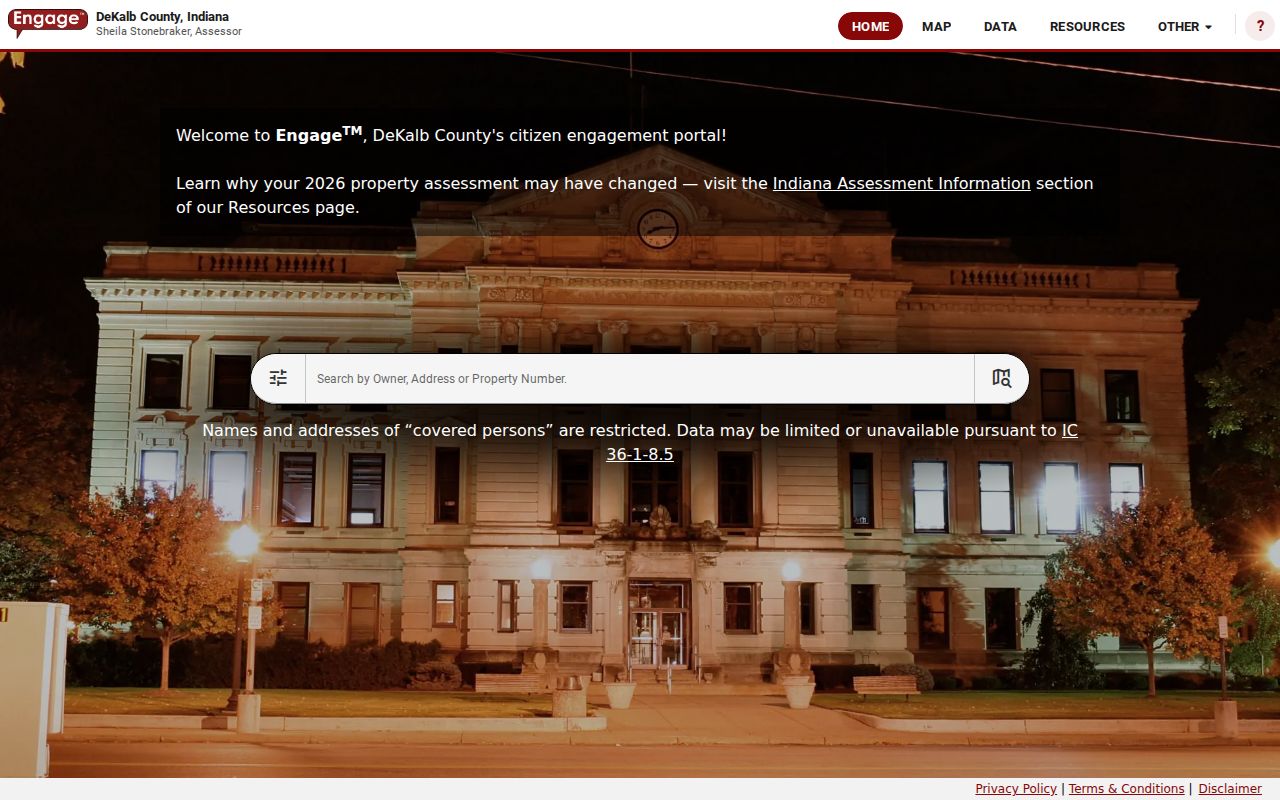
The county's official search page displays its combined owner, address, and property-number entry point. That single screen starts the whole lookup.
- Search the street address in XSoft and copy the complete parcel number and owner-of-record string.
- Check the parcel shape in Beacon so the result matches the intended lot.
- Ask the DeKalb County Recorder for the most recent conveyance and compare its grantee with the roll.
- If the owner is an entity or estate, use the matching official business or probate record for context.
This method beats a name-only web search. It names who owns the tax parcel, while the current-owner record explanation focuses on the present roll and its timing.
DeKalb Address and Owner Fields
The DEVNET property form offers far more search controls than the XSoft landing prompt. It takes a parcel number, owner name, low and high house numbers, street, and city. Sale-price range, sale-date range, township, tax district, property class, neighborhood, and tax years are also covered. Start with one strong field. A parcel number or the last name as printed on a tax bill works best.
House-number ranges help when an address was entered differently. They also work when a whole block needs review. A city label, though, proves nothing about jurisdiction. Ashley and Hamilton cross county lines. An Auburn, Garrett, or Butler postal label may reach beyond the municipal boundary. Always verify the mapped parcel before deciding which office holds a permit file.
Sources Naming DeKalb Property Owners
No single record answers every ownership question. The assessor keeps the current assessment roll, and the Recorder holds authority over conveyances. Beacon adds the map context. DeKalb County publishes no online grantor-grantee index, so the Recorder's counter, phone, and public-record request channels still matter.
| Where ownership appears | What it contributes | How to reach it |
|---|---|---|
| Assessor roll | Owner-of-record string, situs, mailing, parcel, and assessment context | XSoft, DEVNET, assessor phone or counter |
| Recorded deed | Grantee named in the latest recorded conveyance and legal description | Recorder counter, phone, or APRA request |
| Beacon GIS | Parcel location and a bridge to related tax data | County-linked public map |
| INBiz or MyCase | Entity or probate context when the roll names an organization or estate | Official Indiana searches |
An owner of record is not always an occupant. The parcel may sit vacant, carry a lease, or rest inside a trust. It may belong to an LLC instead. Ownership research should follow the legal and assessment trail rather than guess who lives at a particular address.
Separate DeKalb Mailing and Situs
The situs address fixes the property's physical location. The mailing address is where the tax office sends notices. Sometimes they match. Often they do not. An out-of-county mailing address does not mean the owner sold, and a local situs does not prove the owner lives there.
DeKalb County's tax-statement mailing form holds five parcel and address rows and asks whether the new mailing address is a primary residence. It redirects tax mail only. The form amends no deed and installs no new legal owner. Label both fields carefully in your notes.
Note: Give county staff the parcel number first, then the situs address and the exact owner spelling.
Confirm DeKalb Ownership by Deed
A just-recorded deed can be newer than the assessment roll. DeKalb County publishes no fixed update lag and no nightly refresh rule, so no safe number of days can be promised. Call the DeKalb County Recorder at 260-925-2112 and ask for the latest conveyance by parcel, parties, legal description, instrument type, and date range.
The comparison is straightforward. The latest deed's grantee should explain the current ownership claim. Its legal description should match the land in question. A mismatch might point to a recent sale, a parcel split, a name variation, a life estate, a correction deed, or an estate transfer. It calls for more source work, never a guess.
Entity and Estate Owner Names
When XSoft or DEVNET shows an LLC, run the exact business name through Indiana INBiz. The business record can separate similarly named entities and name a registered agent. That agent is not the property's owner. Trusts may appear under a trustee name or a trust label, and the public record may omit every beneficiary.
Estate names need a different route. Search Indiana MyCase for a DeKalb probate matter. Then look for a personal-representative deed, court order, affidavit, survivorship instrument, or later deed. Probate timing and assessment updates can diverge. An estate can linger on the roll long after a court event. The deed remains the land-transfer checkpoint.
DeKalb Ownership Terms Defined
Official records use short terms that carry different weight. Define them before comparing results.
- Owner of record
- The party shown as owner on the current assessment roll.
- Grantee
- The party receiving the interest described in a recorded deed.
- Title
- The legal ownership interest, which a title examination evaluates beyond one database result.
- Situs address
- The physical property address, kept separate from the tax mailing address.
- Legal description
- The formal land description used to match the deed to the parcel.
Protected DeKalb Owner Information
The XSoft notice addresses covered persons. Names or addresses for covered persons can be restricted under IC 36-1-8.5. Indiana also runs an Address Confidentiality Program under IC 5-26.5. A suppressed name or address may therefore be lawful protection. It is not a defect to work around. Ask the custodian what can be released and which statute controls any redaction.
Historic deeds may still carry an old signature or address. Use only what the property question requires. Avoid republishing protected personal details. Public access never authorizes threats, surveillance, impersonation, or any attempt to defeat a confidential address.
Limits of a DeKalb Owner Lookup
A DeKalb County owner lookup has real limits. The assessor's tax roll names the owner of record for assessment purposes. That is useful, but it proves less than people hope. It cannot confirm that the owner actually lives at the parcel, and it will not surface every interest hidden inside a private trust, repair a deed defect, or guarantee clear title. Beacon lines on the GIS map are references for orientation, never a substitute for a survey. A homestead deduction may hint at who resides there through its tax treatment, yet it settles nothing on its own about current occupancy.
Lawful use. DeKalb County owner records support lawful property diligence. An owner name is not a title search, and it must never be used to harass or target anyone.
Serious questions call for more than a search box. Whether the issue is a purchase, an easement, an inheritance, or a disputed interest, pull the recorded instruments from the deed records and get advice from a qualified title or legal professional. Official property records supply the evidence, but no search result from the recorder or assessor adds up to a title opinion.