
Read DeKalb Property Tax Records
DeKalb County property tax records pull from two offices. The Assessor holds parcel and value data. The Treasurer holds bills and collections. Reading a record works better when gross assessed value, deductions, net assessed value, local rates, credits, installments, and the balance stay in separate fields. Indiana assesses real property at 100 percent of market value-in-use, a standard that differs from a recent sale price or an appraisal for sale.
| Field | What It Shows | Where |
|---|---|---|
| Gross assessed value | Land and improvements before deductions | Assessor and DLGF |
| Deductions | Approved reductions used in the tax calculation | Auditor and tax record |
| Net assessed value | Value after deductions | Tax bill |
| Tax rate and credits | Rate and credits applied to the parcel | Tax bill |
| Installments and balance | Due dates, payments, penalties, fees, and amount owed | Treasurer, Gateway, DEVNET |
A recorded sale price can mislead. The sale may be non-arm's-length, include personal property, or reflect a condition that later changed. DLGF ratio studies compare assessments with qualified sales. The constitutional tax caps limit tax, not value. Qualifying homesteads use a 1 percent cap, other residential and agricultural real property 2 percent, and other real or personal property 3 percent.
Search DeKalb Tax Fields
Indiana Gateway takes a pay year, county, taxing district or unit, taxpayer name, address, parcel number, and ranges for district rate or total bill, plus a sort choice. DEVNET broadens the search with parcel, owner, address, sale, township, district, class, neighborhood, and tax-year filters. Find the exact parcel number first. XSoft is the place to get it.
| Search control | Purpose | Common issue |
|---|---|---|
| Pay Year | Selects bills payable in that year | Not the assessment year |
| Taxpayer Name | Finds the bill name | Trust or entity spelling |
| Address | Finds a known site | Mailing and situs may differ |
| Parcel Number | Matches one tax parcel | Keep punctuation and suffix |
| Taxing Unit | Narrows the local rate area | Do not infer it from ZIP alone |
Portal years depend on the data offered when you search. Save the pay year and query date with every result. The official Gateway screen displays DeKalb County's statewide tax-bill route.
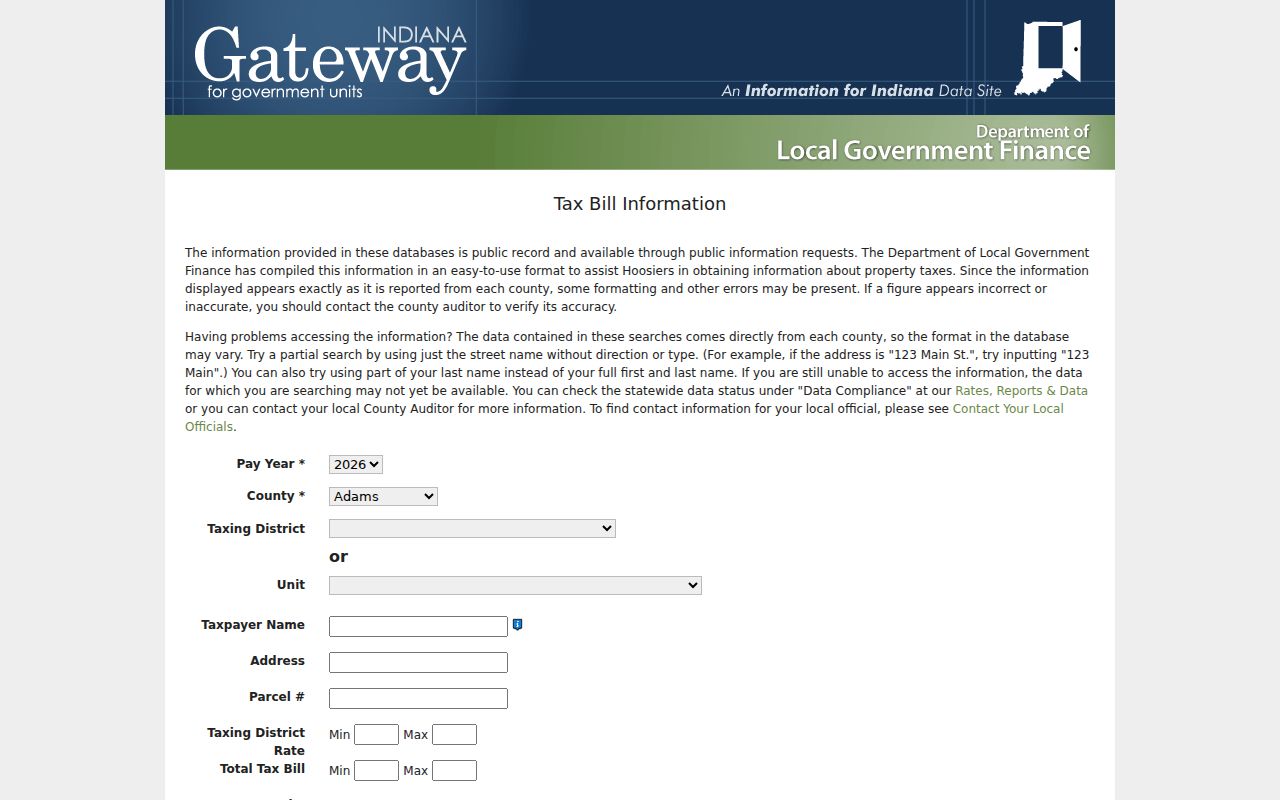
Its filters keep taxpayer, address, parcel, taxing unit, and amount as distinct search facts.
A DeKalb Tax Bill Example
One local sample pairs parcel 17-06-29-485-008.000-025 with Auburn taxing unit 025, Union Township, Ford Place, and an E 7th Street situs. Its 2025 tax year is payable in 2026. Due dates fall in May and November. The bill itemizes tax, delinquent amounts, penalties, fees, adjustments, spring and fall totals, and the balance. The $144.19 fall installment is one parcel's fact. It does not set a county norm. Copy the record completely: parcel, taxing unit, township, legal description, tax year, pay year, each installment, and the current balance. Even so, the bill identifies no owner of record and sets no market value.
Look Up a DeKalb Tax Bill
Start with the parcel number. Compare the assessment and the bill separately. The DeKalb County Treasurer sits at 100 S Main Street in Auburn and answers at 260-925-2712, Monday through Friday, 8:30 a.m. to 4:30 p.m. Call when a closing, payment, delinquency, or sale question needs a current answer from the office.
- Find the parcel number in XSoft or DEVNET and copy it without changing punctuation.
- Search Gateway by pay year, DeKalb County, and parcel or address.
- Record gross value, deductions, net value, rate, credits, installments, due dates, and balance separately.
- Confirm delinquency, payment, or sale status directly with the Treasurer when timing matters.
- Assessed value
- The county value under Indiana's market-value-in-use standard.
- Tax rate or levy
- The local rate applied in calculating tax.
- Homestead deduction
- A qualifying deduction administered through the county auditor.
- Tax lien
- A legal claim tied to unpaid tax, distinct from the bill itself.
DeKalb Deductions and Exemptions
The Indiana DLGF deductions page lists programs administered through county offices. Homestead, over-65, blind or disabled, disabled-veteran, heritage-barn, vacant-building, and tax-abatement forms all appear there. A deduction trims net taxable value. Gross land and improvement values stay untouched. Exemptions under IC 6-1.1-10 generally use Form 136 or a related form. Filing usually must happen before April 1. Even-year refiling may apply unless an exception controls. Eligibility turns on specific facts, so check the current form and the county auditor's process rather than inferring an exemption from a smaller bill.
Change a DeKalb Mailing Address
The county's tax-statement mailing form leaves room for up to five parcel and property-address rows. It asks for the requested mailing address and whether that address is a primary residence. An agent may need a power-of-attorney or trustee attachment. The form only changes where statements go. It leaves the deed, situs, owner, and boundary untouched. Keep those facts separate and send the form through the county's stated Treasurer route.
DeKalb Delinquency and Tax Sales
A delinquent bill starts a status check. It does not prove the land sold. Official DeKalb tax-sale notices cite Indiana's statutory process, list parcel and legal-description details, and set bidder and redemption terms for each sale. The 2025 commissioners-certificate notice used an online auction and described redemption costs, surplus rights, and a bar on delinquent taxpayers bidding. Confirm the current balance and stage with the Treasurer. Then check the county notice, Recorder instruments, and MyCase where a court matter applies. Sheriff mortgage sales follow a separate process and carry a buyer-beware warning. No tax list or sheriff posting guarantees clear title.
Get DeKalb Tax Records Offline
The Assessor works from 100 S Main Street in Auburn. The office is reachable at 260-925-1824 on weekdays from 8:30 a.m. to 4:30 p.m. Assessment-record copies cost 10 cents each. Fax copies run 50 cents. Ask first which office holds the parcel card, sketch, photo, older roll, exemption filing, or appeal record. Do this before paying anything. On the phone, give the parcel number first. Then give the situs address and owner spelling. For a written APRA request, name the record and tax years. Avoid asking for everything. A mailed, emailed, or faxed request generally draws a response within seven calendar days. That response may be an acknowledgment rather than immediate production. The Indiana Public Access Counselor explains the request and review process.
Appeal a DeKalb Assessment
Assessment dates matter here. The DLGF DeKalb calendar shows a June 15, 2026 appeal deadline. Form 11 notices were mailed April 30, 2026. Those dates shift each cycle, so check the calendar before acting. An appeal starts with Indiana Form 130, which DeKalb accepts for disputed assessments.
Build the case before filing. Compare the assessor's property card against the land, improvements, and class it describes. Then line up market-value-in-use evidence, photos, sketches, and comparable sale records tied to the same assessment date. An appeal only contests value. It will not alter a deed, move a parcel line, or settle any ownership claim.
Appeal window. DeKalb County's listed 2026 deadline is June 15. Recheck the DLGF calendar and file Form 130 through the stated county process.